Deck Calculator
Enter your deck's length, width, board size, and material to calculate the exact number of deck boards, joists (the horizontal framing members that support the boards), posts, screws, and concrete bags needed. The calculator defaults to pressure-treated 5/4×6 boards at 16-inch joist spacing and adds 10% waste — switch to composite or diagonal layout to see how your order changes.


- Expert Reviewed
- Updated April 2026
- Sources Cited
- No Login Required
- Free to Use
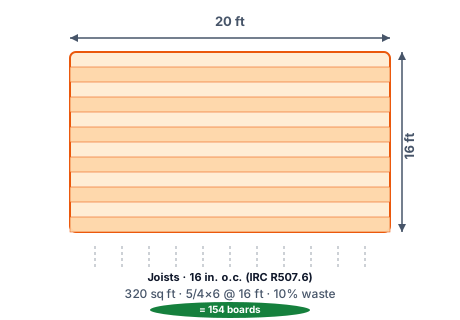
Pressure-Treated Pine. Standard residential decking. 1/8-inch face gap. Acclimate boards on-site 48–72 hours before installation to prevent gapping or cupping.
Longer dimension. Most residential decks are 16–24 ft long.
Shorter dimension (perpendicular to joists). Boards run across the width.
5/4×6 is the most common residential decking. Face width (actual) ≠ nominal.
Standard stock at home improvement stores is 8, 10, 12, 16, or 20 ft.
1/8 in (0.125) for wood · 3/16 in (0.1875) for composite · 1/4 in (0.25) for composite > 16 ft.
16 in o.c. is the IRC R507.6 residential standard. Composite requires 16 or tighter.
Straight = lower waste factor. Diagonal = every board gets an angle cut at each end.
10% straight wood · 12% straight composite · 15% diagonal wood · 20% diagonal composite (NAHB / manufacturer data).
Your deck materials
Deck boards
95 boards
86 raw + 10% waste
Joists
16 joists
16" o.c. · includes rim
Posts
16 posts
8-ft spacing
Est. cost (2026)
$3,200–$4,800 materials
Pressure-Treated · RS Means
Beams
4 beams
8-ft spans
Deck screws
2,800 screws
Face-screw · 2/crossing
Concrete
80 80-lb bags
44 cu ft total
Deck area
400 sq ft
37.2 sq m
Board order tip
Buy the next full bundle of 10 to avoid a return trip — a rule most deck crews follow on jobs under 800 sq ft.
Hidden-fastener alternative
For systems like Camo or Ipe Clip, use approximately half this screw count and add a groove-cutting tool rental.
Deck width exceeds one board length — butt joints or scarf joints will be needed. Consider adding 5% to the waste factor.
Formula: boards = ⌈(deck_width ÷ (board_face + gap)) × (deck_length ÷ board_length)⌉ × (1 + waste). Joists per IRC R507.6 (16 in. o.c. default). Live load 40 psf per IRC R301.5. Materials cost per RS Means 2026 regional data.
Full Materials Checklist
Boards, joists, beams, posts, screws, and concrete bags — the complete shopping list for your deck.
2026 RS Means Cost
Material cost range per square foot, refreshed annually from RS Means 2026.
IRC R507 Reviewed
Joist spans per IRC R507.6 · 40 psf live load per R301.5 · reviewed by Alex Rivera, PE.
Need labor, railing, and regional pricing?
This page handles deck framing and decking materials. The Deck Cost Calculator adds labor, railings, and regional pricing.
Estimates are for planning purposes. Always consult a licensed contractor or structural engineer before ordering materials for decks elevated more than 8 feet above grade, roof decks, or decks supporting hot tubs.
Section 01
How to calculate deck boards
The deck board formula converts deck dimensions into a finished board count in two steps: find how many boards span the width of the deck, then multiply by how many courses run the length. Add a waste factor (10% straight, 15–20% diagonal) and round up.
The deck board formula
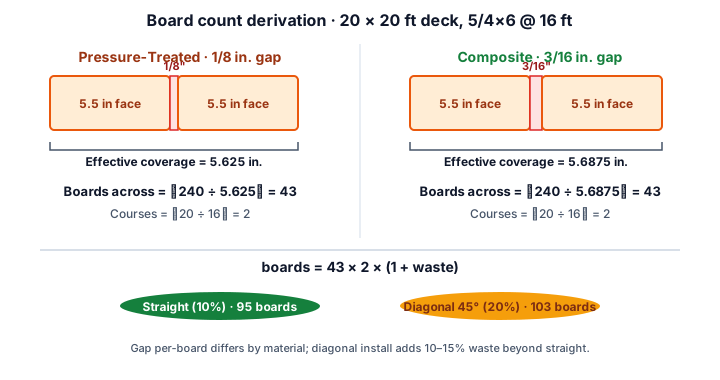
Effective coverage by board size
| Nominal | Face width | PT gap | Composite gap | Eff. (PT) | Eff. (Comp.) |
|---|---|---|---|---|---|
| 1×4 | 3.5 in. | 0.125 in. | 0.1875 in. | 3.625 in. | 3.6875 in. |
| 1×6 | 5.5 in. | 0.125 in. | 0.1875 in. | 5.625 in. | 5.6875 in. |
| 5/4×4 | 3.5 in. | 0.125 in. | 0.1875 in. | 3.625 in. | 3.6875 in. |
| 5/4×6 | 5.5 in. | 0.125 in. | 0.1875 in. | 5.625 in. | 5.6875 in. |
| 2×4 | 3.5 in. | 0.125 in. | 0.1875 in. | 3.625 in. | 3.6875 in. |
| 2×6 | 5.5 in. | 0.125 in. | 0.1875 in. | 5.625 in. | 5.6875 in. |
Waste factor by scenario
| Scenario | Waste | Why |
|---|---|---|
| Pressure-treated, straight install | 10% | Standard rectangular deck, minimal cuts |
| Cedar, straight install | 10% | Similar to PT; add 2% for longer boards or cut-up perimeter |
| Composite, straight install | 12% | Manufacturer guidance — composite scrap is non-returnable in most stores |
| Pressure-treated, 45° diagonal | 15% | Every board has two angle cuts — scrap accumulates on both ends |
| Cedar, 45° diagonal | 15% | Match PT diagonal; increase to 18% for cut-up perimeters |
| Composite, 45° diagonal | 20% | Composite diagonal worst case — no returns, high scrap factor |
Section 02
What your results mean — full materials checklist
The calculator returns seven numbers: board count, joist count, beam count, post count, screw count, concrete bags, and a 2026 cost range. Together they form the complete shopping list for a rectangular deck — nothing missing, nothing extra.
Board count
The number of deck boards at your chosen nominal size (default 5/4×6) and standard board length (default 12 ft), waste-adjusted. Round up to the nearest bundle — lumberyards typically package decking in 10-board bundles.
Joist count
Calculated as ⌈deck_length_in ÷ joist_spacing_in⌉ + 1 (rim joists included). Default spacing is 16 in. o.c. per IRC R507.6. Composite decking forces 16 in. o.c. or tighter to meet manufacturer warranty terms.
Beam count + post count
Based on a conservative 8-foot maximum beam span between posts. A 20 × 20 ft freestanding deck needs 3 beams × 3 post rows = 9 posts. An attached deck with a ledger needs posts only on the outer rows.
Screw count
Face-screw install: 2 screws per joist crossing, rounded up to the nearest 100. Hidden-fastener systems (Camo, Ipe Clip) use 1 fastener per crossing but require groove boards and a groove-cutting tool — divide screw count by 2 for hidden systems.
Concrete bags
Assumes a 12-in. sonotube at 42-in. depth per post ≈ 2.75 cu ft ≈ 5 bags of 80-lb premixed concrete. Multiply by post count. Adjust sonotube diameter in the Sonotube Calculator for larger posts.
2026 cost range
Square footage × low-to-high $/sf for the selected material: PT $8–$12, cedar $12–$18, composite $18–$25. Materials only — labor, railing, and stairs are priced on the Deck Cost Calculator.
Section 03
Composite vs. pressure-treated lumber
Material choice changes three calculator inputs automatically: gap spacing, maximum joist spacing, and waste factor. Pressure-treated pine and western red cedar use a 1/8-inch gap at up to 24 in. o.c. joists. Composite decking requires a 3/16-inch end gap and caps joist spacing at 16 in. o.c. per manufacturer warranty.
| Material | Gap | Max joist spacing | Lifespan | 2026 cost / sf | Maintenance |
|---|---|---|---|---|---|
| Pressure-Treated Pine | 1/8 in. | 24 in. o.c. | 10–15 yr | $8–$12/sf | Stain every 2–3 years |
| Western Red Cedar | 1/8 in. | 24 in. o.c. | 15–20 yr | $12–$18/sf | Stain or oil annually |
| Composite (Trex / Fiberon) | 3/16 in. | 16 in. o.c. | 25–30 yr | $18–$25/sf | Wash only — no sealing |
Source: RS Means Residential Cost Data 2026 + manufacturer specifications (Trex, Fiberon, TimberTech).
Why composite needs a bigger gap
Wood-polymer composites expand and contract with temperature much more than solid wood. The 3/16-inch end gap is the manufacturer's thermal-expansion allowance for boards up to 16 feet; boards longer than 16 feet require a 1/4-inch gap. Installing composite at 1/8-inch gap causes buckling when boards expand in summer heat — a common warranty denial.
Pressure-treated board acclimation
Pressure-treated lumber leaves the kiln with high moisture content. Installing it before the boards dry to equilibrium moisture causes post-installation gapping as the boards shrink. The fix is simple: let boards sit on-site for 48–72 hours, stickered flat, covered against rain, before cutting them to length.
Section 04
Footings and framing guide
Residential decks are built around three fixed code points: IRC R301.5 requires a 40 psf live load; IRC R507.6 sets joist spans by lumber species and size; and IRC R507.9 governs ledger-to-house attachment — the single most common cause of deck collapse. Footings must extend below the local frost line, which ranges from 0 inches (deep South) to 72 inches (northern Minnesota).
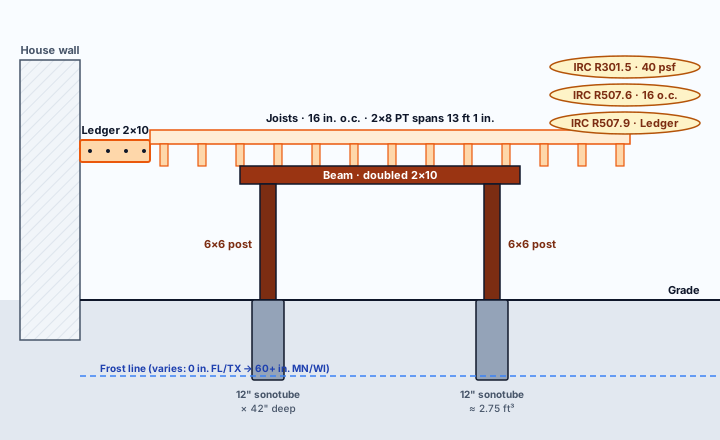
IRC R507.6 joist spans (pressure-treated southern pine)
| Joist size | 12 in. o.c. | 16 in. o.c. | 24 in. o.c. |
|---|---|---|---|
| 2×6 | 9 ft 11 in. | 9 ft 0 in. | 7 ft 7 in. |
| 2×8 | 14 ft 4 in. | 13 ft 1 in. | 10 ft 9 in. |
| 2×10 | 18 ft 0 in. | 16 ft 5 in. | 13 ft 5 in. |
| 2×12 | 21 ft 9 in. | 19 ft 10 in. | 16 ft 3 in. |
Source: IRC 2021 Table R507.6. Other lumber species (Douglas fir, hem-fir, spruce-pine-fir) have smaller spans — consult the full IRC R507.6 table for your specific lumber.
Frost line and footing depth
Footings must extend below your local frost line to prevent freeze-thaw heaving. Approximate ranges: Gulf Coast 0–12 in., mid-Atlantic 24–32 in., Great Lakes 42–48 in., northern plains 60–72 in. Contact your local building department for the exact code-required depth — this is not a guess-and-check specification.
Post sizing: 4×4 vs. 6×6
For decks elevated less than 8 feet above grade, 4×4 pressure-treated posts are typically acceptable. For decks more than 8 feet elevated, use 6×6 posts minimum and consult a structural engineer. Multi-story decks, roof decks, and decks supporting hot tubs always require PE-stamped structural drawings.
Section 05
Deck build sequence
A deck is built from the ground up in a fixed order — skipping or re-ordering steps creates rework. Each calculator output corresponds to a specific construction phase: use this table as a project timeline so you know when each material gets installed and when to order it.
| Phase | What happens | Calculator output used |
|---|---|---|
| 1. Footings | Dig post holes below frost line, set sonotubes, pour concrete | Concrete bags, post count |
| 2. Framing | Attach ledger (if applicable), set posts, install beams | Post count, beam count |
| 3. Joists | Install joists on hangers at 16 in. o.c. (or 12 in. for composite) | Joist count |
| 4. Decking | Install deck boards with correct gap, stagger butt joints | Board count |
| 5. Fasteners | Face-screw 2 screws per joist crossing — or use hidden system | Screw count |
| 6. Railing & Stairs | Install railing, then build stairs last (measure after framing) | (Use Stair Calculator) |
| 7. Finish | Stain/seal pressure-treated or cedar after 30-day dry | (Use Deck Stain Calculator) |
Timing the stair and railing calculators
Stair and railing quantities depend on final deck elevation, which is only fixed after framing is complete. Order stair stringers and railing components after the framing inspection, not before. Use the Stair Calculator for tread/riser counts and the Deck Stain Calculator for finish volume.
Section 06
Cost estimator (2026)
Deck material cost is a direct function of square footage and material choice. Pressure-treated pine ($8–$12/sf) is the most common budget choice. Cedar ($12–$18/sf) offers natural rot resistance. Composite ($18–$25/sf) is roughly 2× the upfront cost of PT but has a 25-year service life — lower lifetime cost per year.
Worked example — 400 sq ft deck (20 × 20)
Deck size: 20 × 20 = 400 sq ft
Pressure-treated: 400 × $8–$12 = $3,200–$4,800
Cedar: 400 × $12–$18 = $4,800–$7,200
Composite (Trex-class): 400 × $18–$25 = $7,200–$10,000
Materials only. Add 50–100% for labor, railings, stairs, footings, and finish — see the Deck Cost Calculator for a full project budget.
Section 07
Standards and methodology
The board-count formula is derived directly from board face width + gap coverage. Joist spans are taken from IRC 2021 §R507.6. Live load (40 psf) is from IRC R301.5. Cost ranges come from RS Means Residential Cost Data 2026. All formulas are transparently published and reproducible.
Codes and data sources
Section 08
Calculator test cases
The six test cases below are the benchmark scenarios used to verify every change to the calculator. Expected outputs are published so anyone can reproduce the math. TC-03 shows the composite 16-in.-o.c. cap; TC-04 shows the diagonal waste premium on an identical deck footprint.
| Test # | Inputs | Sq ft | Boards | Joists | Cost |
|---|---|---|---|---|---|
| TC-01 | 20×20, 5/4×6, 12-ft, PT, straight, 10% waste | 400 sf | 80 boards | 16 joists | $3,200–$4,800 |
| TC-02 | 12×16, 5/4×6, 16-ft, PT, straight, 10% waste | 192 sf | 30 boards | 10 joists | $1,536–$2,304 |
| TC-03 | 16×24, 5/4×6, 12-ft, Composite, straight, 12% waste | 384 sf | 83 boards | 19 joists | $6,912–$9,600 |
| TC-04 | 20×20, 5/4×6, 12-ft, PT, 45° diagonal, 15% waste | 400 sf | 92 boards | 16 joists | $3,200–$4,800 |
| TC-05 | 10×10, 5/4×6, 12-ft, Cedar, straight, 10% waste | 100 sf | 20 boards | 9 joists | $1,200–$1,800 |
| TC-06 | 40×40, 2×6, 16-ft, PT, straight, 10% waste (large) | 1,600 sf | 260 boards | 31 joists | $12,800–$19,200 |
Exact totals vary slightly from the calculator by the rounding rule applied at each step — board count rounds up per course, screws round up to the nearest 100.
Section 09
Deck calculator FAQ
The 15 questions below cover the deck-board formula, joist spacing, footing depth, composite vs. pressure-treated, permit thresholds, and the most common first-deck mistakes. The first eight are featured in the FAQPage schema; the remaining seven are available for deeper research.