Asphalt Calculator
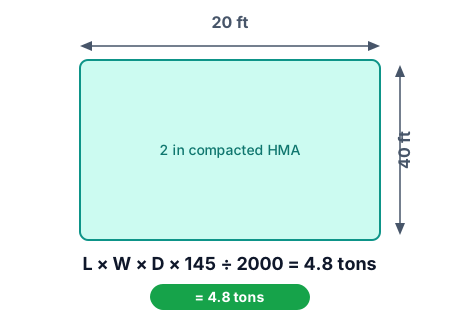
A standard 20 × 40 ft two-car driveway paved at 2 inches of compacted hot mix asphalt requires approximately 4.8 tons of material — and getting that number right before calling your paving contractor prevents short deliveries, scope disputes, and costly second runs. Hot mix asphalt is a composite paving material made from aggregate, sand, and a petroleum-based asphalt binder, mixed and placed at temperatures between 275°F and 300°F. Unlike concrete or gravel, asphalt is ordered and delivered by the ton, not by the cubic yard — which means your tonnage estimate directly controls your material cost and your contractor conversation. This calculator takes your dimensions and target thickness, applies the standard density of 145 lb/ft³, and returns tons needed with a 2026 regional cost range so you go into every estimate prepared, not surprised.

- Expert Reviewed
- Updated April 2026
- Sources Cited
- No Login Required
- Free to Use
Driveway, parking lot, or road section
Longest dimension of the driveway, parking lot, or road section.
Short dimension of the rectangle.
Final compacted depth. Driveway: 2–3 in. Parking lot: 3–4 in.
Standard dense-graded HMA. Default for driveways and parking lots.
Covers spillage, edging, and short deliveries. Default 10%.
Paving season check
Hot mix asphalt requires 50°F ambient, rising, at placement. Compaction must finish above 175°F. In most US climates, the paving window runs April through October.
Tons of asphalt (with 10% waste)
10.63tons
2026 cost estimate
$1,010–$1,861
Clean tons
9.67 tons
Cubic yards
4.94 cu yd
Area
800 sq ft
Coverage / ton
83 sq ft
Loose tonnage equivalent
13.05 tons (×1.35 compaction)
Place 2.7" loose to finish at 2" compacted.
Truckload plan (22-ton truck)
0 full + 10.63 tons partial
Most HMA plants deliver 20–25 tons per truck.
Formula: Tons = (L × W × Tft × 145) ÷ 2000 · Density source: Asphalt Institute MS-4 · Cost source: RSMeans 2026 (delivered, national band).
Estimates are for material planning. For engineered pavements, loading-dock thickness design, or DOT work, consult a licensed civil engineer or your paving contractor before ordering.
Three Shape Modes
Rectangle, circle, and custom-area entry for L-shapes and curves.
2026 RSMeans Cost
National delivered range, $95–$175/ton, refreshed quarterly.
PE-Verified Formula
Asphalt Institute MS-4 density, reviewed by Alex Rivera, PE.
Estimates are for planning purposes. Consult a licensed paving contractor for engineered applications.
Section 01
How the Asphalt Calculator Works
The calculator multiplies your paved area by compacted thickness, then converts cubic feet to tons using the Asphalt Institute MS-4 standard density of 145 lb/ft³. Enter length and width (or diameter, or a custom square-foot area), pick a compacted thickness in inches, and the result is a ready-to-order tonnage plus a 2026 delivered-cost range.
The three shape modes — rectangle, circle, and custom area — cover every residential and light commercial paving scenario. Rectangle handles driveways, parking lots, and road sections. Circle handles roundabouts and circular drives. Custom area takes an L-shape, curved driveway, or irregular footprint measured with a tape and broken into rectangles. All three modes use the same volume-to-tonnage conversion.
Outputs include tons (primary ordering unit), cubic yards (secondary volume reference), a cost range drawn from the RSMeans 2026 dataset, coverage per ton at your entered thickness, and a truckload plan at 22 tons per truck. The calculator returns compacted tonnage — if you are ordering loose material, apply the 1.35 compaction factor described in the compaction section below.
Section 02
Asphalt Tonnage Formula
Asphalt tonnage equals length × width × thickness (in feet) × 145 lb/ft³ ÷ 2,000. The 145 lb/ft³ constant is the Asphalt Institute MS-4 standard density for compacted hot mix asphalt. Thickness in inches is converted to feet by dividing by 12 before the multiplication.
Worked example — 20 × 40 ft driveway at 2 inches thick
A 20 × 40 ft two-car driveway at 2 inches of compacted HMA is the reference scenario used in every competitor calculator and every asphalt industry example. Walking through the full calculation shows exactly how waste factor and density interact.
Inputs: L = 20 ft, W = 40 ft, T = 2 in = 0.167 ft, density = 145 lb/ft³
Step 1. Area = 20 × 40 = 800 sq ft
Step 2. Volume = 800 × 0.167 = 133.3 cu ft
Step 3. Weight = 133.3 × 145 = 19,333 lb
Step 4. Tons = 19,333 ÷ 2,000 = 4.84 tons (clean)
Step 5. + 10% waste: 4.84 × 1.10 = order 5.32 tons
At $125/ton delivered, this driveway runs about $665 in material. Add $2–$4 per sq ft for labor and installation on top.
For recycled asphalt pavement (RAP), substitute a density of 110 lb/ft³ in the formula; for Stone Matrix Asphalt (SMA), use 148 lb/ft³. Both options are selectable in the density dropdown above. If you start from the total area in square feet instead of length × width, skip Step 1 and enter the area directly into the custom-area mode. See the cubic yards calculator if you need cubic-yard output for contract paperwork.
Section 03
How Thick Should Asphalt Be?
Residential driveways need 2 to 3 inches of compacted hot mix asphalt on a 4–6 inch aggregate base. Light commercial parking lots need 3 to 4 inches; heavy-duty lots, bus terminals, and truck loading docks need 4 to 8 inches. Asphalt Institute MS-22 defines these thickness tiers by traffic load and subgrade strength.
| Application | HMA (compacted) | Aggregate base | Reference |
|---|---|---|---|
| Residential driveway (1–2 cars) | 2–3 inches | 4–6 inches crushed stone | Industry standard / APAO |
| Heavy residential (SUVs, light trucks) | 3 inches | 4–6 inches compacted stone | Industry standard |
| Commercial parking lot (light duty) | 3–4 inches | 6–8 inches base | Asphalt Institute MS-22 |
| Parking lot (heavy duty / buses) | 4–6 inches | 8–12 inches base | Asphalt Institute MS-22 |
| Truck loading dock / heavy haul | 6–8 inches | 12 inches base | Asphalt Institute / DOT |
| Pathway / walking trail | 1.5–2 inches | 4 inches compacted stone | Standard trail specification |
Source: Asphalt Institute MS-22 (Thickness Design — Asphalt Pavements) and APAO residential driveway standards. Sub-base specifications reference local geotechnical conditions and frost depth.
Residential driveway thickness — single lift or two-course
Two-inch single-lift is the industry minimum for a residential driveway and is common for budget-conscious jobs. Three-inch two-course construction — a 2-inch binder course topped with a 1-inch surface course — is recommended when the driveway will see occasional delivery trucks, propane trucks, or a contractor dumpster. The two-course approach also improves smoothness and reduces surface reflection cracking over the base layer.
Parking lot thickness by traffic load
Light-duty parking lots (office, retail, employee parking) use 3 inches of HMA over 6–8 inches of crushed stone base. Heavy-duty lots with bus, delivery truck, or municipal fleet traffic use 4–6 inches over 8–12 inches of base. Truck loading docks and heavy-haul areas require 6–8 inches of HMA on a full-depth 12-inch base. Matching thickness to the loaded-axle count from Asphalt Institute MS-22 prevents rutting and premature fatigue cracking.
Section 04
Paving Temperature Window
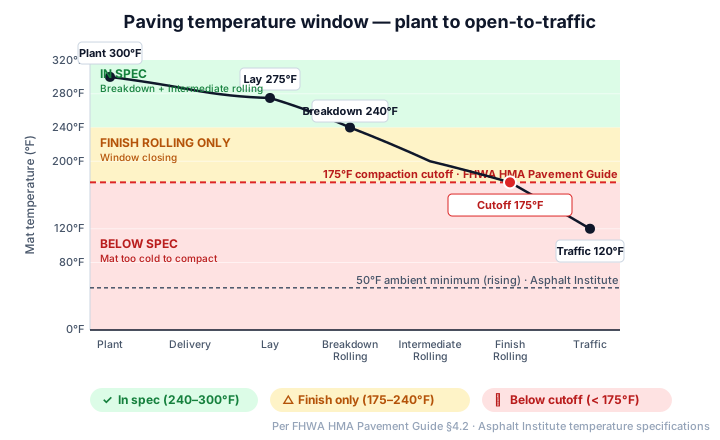
Hot mix asphalt must be placed when ambient temperature is 50°F (10°C) or above and rising. The mix leaves the plant at 275°F–300°F and must be fully compacted while the mat is above 175°F. Below that cutoff, the mix has stiffened and roller passes no longer achieve target density.
Plant temperature
275°F–300°F
Mix leaves the plant within this window. Covered trucks hold temperature for 30–45 minutes of haul.
Compaction cutoff
175°F
Finish rolling before the mat drops below 175°F. Thin lifts cool faster; monitor with a probe.
Ambient minimum
50°F rising
Do not pave below 50°F or onto wet sub-grade. Rain during placement voids compaction density.
Paving season by US region
Paving season is set by the first day of reliable 50°F ambient and the last day before overnight freezes return. Warm-climate states pave close to year-round; high-altitude and Northeast states pave five months a year.
| Region | Paving season | Limiting factor | Active months |
|---|---|---|---|
| Northeast (NY, MA, PA, CT, NJ) | May – October | Nov–Apr: cold; freeze risk | 5 months |
| Midwest (OH, IN, IL, MI, WI) | April – October | Nov–Mar: frost; spring thaw | 7 months |
| Southeast (FL, GA, AL, SC, NC) | March – November | Dec–Feb: limited | 9 months |
| Southwest (TX, AZ, NM, OK) | March – November | Dec–Feb: limited; heat Jul–Aug | 9 months |
| Mountain (CO, UT, MT, WY) | May – September | High altitude; early frost | 5 months |
| West Coast (CA, WA, OR) | Year-round (CA, southern OR) | WA: Nov–Mar rain season | Year-round to 9 months |
Source: FHWA HMA Pavement Guide and Asphalt Institute temperature guidance. Regional dates bracket typical practice; local paving contractors track last-frost and first-frost dates for their service area.
Section 05
Compaction Factor: Why Loose Doesn't Equal Compacted
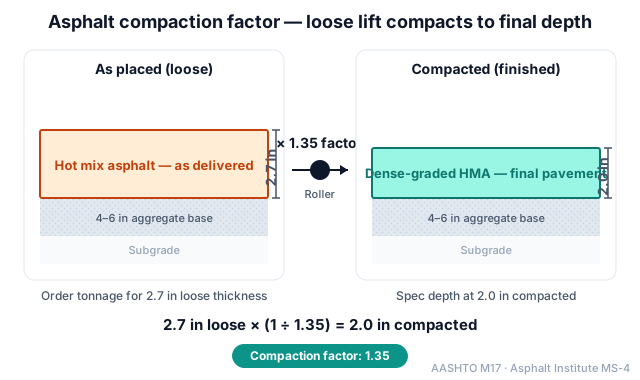
Hot mix asphalt has a compaction factor of approximately 1.35 — meaning 2.7 inches of loose mix compact down to 2 inches of finished pavement. To achieve a 2-inch compacted depth, either place the mix at 2.7 inches loose or multiply your calculated tonnage by 1.35 when ordering loose material.
How to adjust your order for compaction
The calculator returns compacted tonnage by default, which is what most contractors quote against and what shows up on the paving drawing. If you are buying directly from the plant and placing the material yourself, confirm whether the quote is loose tons (as-delivered on the truck) or compacted tons (after rolling). The difference is real material: a 5-ton compacted order is roughly 6.75 tons loose. Contract disputes most often trace back to this ambiguity, not to a computation error.
Practitioner note · Marcus Johnson, CCM
On a standard 20 × 40 ft residential driveway at 2 inches of HMA, I always order 5.3 tons — the calculator's 4.84 clean tons plus a 10% waste cushion. In 15 years of residential and commercial site work, I have never regretted that extra half-ton. The compaction factor is the piece homeowners consistently underestimate: what goes on the truck at 2.7 inches loose comes off the roller at 2.0 inches compacted. If you order exactly to the compacted calculation and your subgrade has a low spot, you run short — and a second delivery costs more than the cushion ever would.
Target compaction density
Finished pavement should reach 92–96% of theoretical maximum density (TMD), which corresponds to 4–8% air voids, per Asphalt Institute MS-4 and AASHTO specifications. Crews hit that target with a three-phase rolling pattern: breakdown rolling (3–4 passes with a static or vibratory steel roller), intermediate rolling (3–5 passes with a pneumatic tire roller to seal the surface), and finish rolling (2–3 static passes to remove roller marks). All three phases must complete before the mat drops below 175°F.
Section 06
What Mix Type Do I Need?
Residential driveways and commercial parking lots use dense-graded hot mix asphalt (HMA) as the surface course. High-traffic roads use Stone Matrix Asphalt (SMA) for rut resistance. Wet-climate surfaces use Open-Graded Friction Course (OGFC) for hydroplaning reduction. Structural base layers use a larger- aggregate base mix below the surface course.
| Application | Recommended mix | Notes |
|---|---|---|
| Residential driveway (surface) | Dense-graded HMA (9.5mm NMAS) | Standard; smooth surface; widely available |
| Commercial parking lot (surface) | Dense-graded HMA (12.5mm NMAS) | Higher traffic load rating; larger aggregate |
| High-traffic road or commercial | Stone Matrix Asphalt (SMA) | Rut-resistant; municipal/commercial use |
| Wet-climate or permeable surface | Open-Graded Friction Course (OGFC) | Permeable; reduces hydroplaning |
| Structural base/binder course | Dense-graded base mix | Larger aggregate; structural strength layer |
| Pothole repair / temporary | Cold mix asphalt | Ambient temp; no paving equipment required |
Source: Asphalt Institute MS-4 mix design guidance and FHWA pavement design references. NMAS refers to Nominal Maximum Aggregate Size.
Dense-graded HMA vs. SMA vs. OGFC
Dense-graded HMA is the all-purpose paving material. It combines coarse and fine aggregate with asphalt binder to produce a low-void, smooth-riding surface that handles most residential and commercial traffic. Stone Matrix Asphalt replaces much of the fine aggregate with asphalt-rich mastic, producing a stone-on-stone skeleton that resists rutting under heavy or slow-moving loads — municipal roads, bus routes, and industrial sites. Open-Graded Friction Course deliberately leaves 15–25% air voids so that water drains through the surface, reducing hydroplaning on highway surfaces in high-rainfall climates.
For ordering, the density value changes with mix type. The calculator defaults to 145 lb/ft³ (dense-graded HMA), switches to 110 lb/ft³ for recycled asphalt pavement, and 148 lb/ft³ for SMA. Always confirm the specified mix on the plant's delivery ticket before the first truck arrives.
Section 07
2026 Asphalt Cost by Region
Hot mix asphalt costs $80–$175 per ton delivered in 2026, with Southeast states averaging $95–$130/ton and the Northeast averaging $130–$175/ton. Prices move with crude oil costs, haul distance from the plant, and order volume. Labor and installation add $2–$4 per square foot above the material price.
2026 hot mix asphalt cost by US region
| Region | HMA — plant gate | HMA — delivered |
|---|---|---|
| Southeast (FL, GA, AL, SC) | $80–$110/ton | $95–$130/ton |
| Southwest (TX, AZ, NM) | $85–$115/ton | $100–$135/ton |
| Midwest (OH, IN, IL, MI) | $90–$120/ton | $105–$140/ton |
| Mountain (CO, UT, MT, WY) | $95–$130/ton | $110–$150/ton |
| Northeast (NY, MA, PA, CT) | $110–$150/ton | $130–$175/ton |
| West Coast (CA, WA, OR) | $100–$140/ton | $120–$165/ton |
Source: RSMeans 2026 Facilities Construction Cost Data. Prices reflect hot mix at plant gate and delivered to a job site within 30 miles of the plant. Labor, installation, site prep, and sub-base material are billed separately. Last verified: April 2026.
What affects asphalt price?
Asphalt binder is a petroleum product, so roughly 30–40% of material price tracks crude oil. Spot price changes take 30–60 days to flow through to the plant gate, which is why regional pricing benchmarks are refreshed quarterly on this page. Haul distance is the second factor: deliveries beyond 30 miles add $5–$15 per ton for trucking and more if the mix has to be reheated.
Order volume, mix specification, and season also move price. Orders of 20+ tons typically earn a $5–$10 per-ton volume discount. Premium mixes (SMA, polymer-modified binder) add $10–$30 per ton. Early-season and late-season work often carries a 5–10% surcharge because plants run at lower volume and cost per ton rises. For a full project cost including labor, forming, and finishing, pair this calculator with a dedicated cost calculator downstream.
Section 08
Asphalt Coverage per Ton (Quick-Reference Table)
One ton of hot mix asphalt covers approximately 110 sq ft at 2 inches thick, 73 sq ft at 3 inches thick, or 55 sq ft at 4 inches thick. Thicker lifts cover less area per ton because more weight is needed per square foot of pavement. The table below maps the five standard thicknesses to tons per 100 sq ft and tons per 100 sq yd.
| Thickness (compacted) | Tons per 100 sq ft | Tons per 100 sq yd |
|---|---|---|
| 1.5 inches | 0.82 tons | 7.4 tons |
| 2 inches | 1.09 tons | 9.8 tons |
| 2.5 inches | 1.36 tons | 12.2 tons |
| 3 inches | 1.63 tons | 14.7 tons |
| 4 inches | 2.18 tons | 19.6 tons |
Calculated from the Asphalt Institute MS-4 standard HMA density of 145 lb/ft³. Values apply to compacted pavement. For loose material (as-delivered), multiply by 1.35.
Section 09
Do I Need a Gravel Base Under Asphalt?
Residential driveways need a 4–6 inch compacted aggregate base under the hot mix asphalt surface. Commercial parking lots need 6–8 inches; heavy-duty lots and loading docks need 8–12 inches. The base spreads wheel loads to the subgrade, prevents frost heave, and drains water away from the pavement bottom.
The standard base material is crushed limestone or crushed granite graded to a ¾-inch minus specification (often called Class 5, CA-6, or ABC depending on the state DOT). It compacts to 95% of maximum dry density under a vibratory plate or smooth-drum roller and locks together so the asphalt surface above does not shift under load. Freeze-thaw climates often require 6–8 inches instead of 4 on residential jobs because frozen subgrade heaves unevenly.
To size the gravel volume for your sub-base, use the dedicated gravel base calculator. The input is the same paved area with a depth of 4–6 inches; the output is cubic yards of crushed stone at the standard 2,700 lb/cu yd compacted density. Plan for a 10–15% waste factor because crushed stone settles more than asphalt.
How long does asphalt take to cure before opening to traffic?
Hot mix asphalt can typically open to foot traffic within 2–4 hours of completion, once the surface temperature has cooled below 120°F. Passenger vehicles can drive on the pavement after 24–48 hours. Heavy trucks and loaded equipment should stay off new asphalt for at least 3–5 days to allow the binder to harden fully — driving heavy equipment on warm pavement causes ruts and edge cracking that are expensive to repair.
Cure time is longer in hot weather because the pavement retains heat. In summer in the Southeast or Southwest, allow an extra 12–24 hours before allowing passenger vehicles. In spring or fall, cool nights accelerate cooling and the pavement may be ready sooner. The FHWA opening-temperature guideline is 120°F mat temperature, measured with an IR thermometer or probe at mid-depth.
Full long-term cure, where the asphalt binder reaches its final hardness, takes 6–12 months. During the first season, avoid sustained heavy loads in the same tire track (wheel ruts form most easily when the binder is still soft), and seal-coat the surface 6–12 months after installation to slow binder oxidation.
Section 10
Methodology and Sources
Every number on this page is tied to a published standard or a verifiable industry dataset. The tonnage formula, density value, thickness recommendations, paving temperature window, compaction factor, and cost ranges are all sourced below. Cost data is refreshed quarterly; formula and standards citations are stable across 2025–2026.
Standards and references cited on this page

Reviews: project calculators · 31 calculators reviewed
Marcus Johnson is a Certified Construction Manager (CCM) with 20 years of experience in residential and commercial site work. He holds CCM certification from CMAA (member #2019-1247). He has managed NALP-member landscape installation projects covering more than 2 million square feet of site work. At CalcSummit, he writes all landscape volume and bulk-material calculators, applying field-tested coverage rates for mulch, gravel, sand, topsoil, and fill dirt.
Full profile →Published April 2026 · Last reviewed April 2026 · Next cost-data review July 2026. Formula and standards co-reviewed by Alex Rivera, PE. Field practicality reviewed by Marcus Johnson, CCM (1,200+ residential and commercial site-work projects).
Scope note: this page provides estimating guidance reviewed by our CCM author and PE reviewer for residential and light-commercial paving. For engineered highway, airport, or structural pavement design, a licensed civil engineer of record should produce the thickness design and material specification.
Section 11